
Map Your Business Architecture
Get aligned and turn your strategy into action.
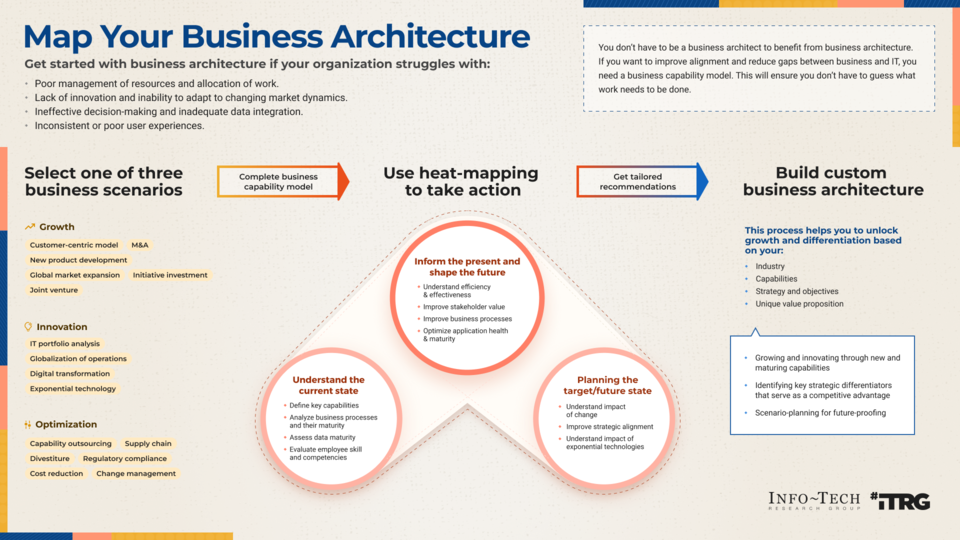
Organizations today face relentless pressure to move faster, innovate, and scale transformation – yet many struggle to turn strategy into meaningful results. Without a clear view of how value is delivered across the organization, decision-making is little more than guesswork. Business architecture is the map that connects strategy with execution. This blueprint takes a practical, accessible approach to building a business capability map, linking it to value streams, and prioritizing the right initiatives to deliver results.
As organizations seek meaningful results in today’s exponential world, many struggle with enterprise-level blind spots when it comes to how they create and deliver value. This makes it difficult to prioritize initiatives, optimize cross-functional performance, or align investments with the outcomes that matter most. Business architecture provides a holistic view of the organization’s activities and the resources that support them and how they can be aligned to better connect strategy with action.
1. Business architecture is for everyone.
You don’t need a dedicated practice to start benefitting from business architecture. Start with a business capability map to expose how your organization creates value. This will reduce the guesswork, improve alignment between the business and IT, and connect what needs to get done with how value is actually delivered.
2. Speaking of value …
In business architecture, value streams visually define and show how the organization delivers outcomes, not just how work flows. Value streams are foundational to identifying which capabilities matter most and where to prioritize improvements for impact.
3. Zoom out for the full picture.
Enterprise and business architecture aren’t just about IT. Business capabilities and governance approaches need to fully reflect corporate strategy and governance. If they take place in isolation, planning becomes myopic and disconnected from its purpose.
Use this step-by-step blueprint to begin your business architecture journey
Use this comprehensive framework with practical tools and templates to help you build a capability map, model value streams, and focus on the initiatives that will have the greatest strategic impact. Follow a three-phase process that walks you through how to:
- Engage your stakeholders. Recognize the opportunity for mapping work and identify and engage the right stakeholders.
- Define your value streams. Articulate how your organization delivers value to your customers.
- Drive business architecture forward. Assess your current projects to determine if you are investing in the right capabilities. Conduct business capability assessments to identify opportunities and prioritize projects.
Member Testimonials
After each Info-Tech experience, we ask our members to quantify the real-time savings, monetary impact, and project improvements our research helped them achieve. See our top member experiences for this blueprint and what our clients have to say.
9.1/10
Overall Impact
$49,672
Average $ Saved
16
Average Days Saved
Client
Experience
Impact
$ Saved
Days Saved
Anglicare Sydney
Guided Implementation
9/10
$1,862
2
Advice helped confirm some of what we were doing is right but also gave us other lenses to look at the work from
Leavitt Industrial Group
Guided Implementation
10/10
$10,000
2
Andrea has everything I need. Personable and responsive. We aligned and she helped build my thinking
Psac
Workshop
9/10
$136K
50
Great facilitation, more pre-work would have been appreciated.
Department for Education
Guided Implementation
9/10
N/A
5
Consumers Energy
Workshop
9/10
$68,000
20
Great experience coordinating with Howard on the workshop, especially around preparing our to-be processes and items our team will be responsible f... Read More
Paychex
Workshop
8/10
N/A
N/A
Ivan was a great facilitator: knowledgeable and approachable. He stayed curious throughout and asked meaningful questions of the audience to tease ... Read More
Consumers Energy
Workshop
10/10
$136K
44
Best: I deeply appreciate the iterative and highly collaborative approach to ensuring the workshop scope, delivery, and outcomes were aligned to o... Read More
Consumers Energy
Workshop
8/10
$68,000
20
Great engagement from Howard during the delivery of the workshop. The team learned some valuable practices and insight from the Business Architectu... Read More
New Zealand Treasury
Guided Implementation
10/10
$13,534
10
Cameron was very knowledgeable on the topic and provided some valuable insights and suggestions on how to right-size for our organization.
DKV Euro Service GmbH + Co. KG
Guided Implementation
9/10
$39,749
5
Oklahoma Office of Management and Enterprise Services
Workshop
10/10
$34,000
20
Having everyone in a room for 4 days, the exchange of ideas and issues were great. This built the foundation to carry the project forward.
Agriculture & Agri-Food Canada
Guided Implementation
10/10
$5,000
5
NZ Department of Corrections
Guided Implementation
7/10
$34,250
10
Collateral and analyst session was very interesting and informative, we were looking for an accelerator for general business capabilities and recei... Read More
California Health and Human Services Agency
Guided Implementation
10/10
$28,085
N/A
Best part is having access to speak with a knowledgeable person in the space. Worst part is that I don't have access to her every minute of every day.
NASA
Workshop
10/10
N/A
120
Best parts: great knowledgeable and highly skilled team. High level of engagement by all participants. Flexibility in adjusting agenda items based ... Read More
Centennial College
Guided Implementation
10/10
$10,000
16
Best: Great insight into the discipline and practical blueprints that once can actually use and refine Thanks Claude
USAble Mutual Insurance Co. dba Arkansas Blue Cross and Blue Shield
Workshop
9/10
$1.23M
N/A
Andy drove the Value stream mapping exercise by establishing capability model for Group line of business for Arkansas Blue Cross Blue Shield. Andy... Read More
BearingPoint
Guided Implementation
9/10
$9,000
5
really good overview of the approach and blueprint thank you Adib
Palm Beach State College
Workshop
10/10
$136K
50
Expertise of the advisors was excellent. Never enough time to accomplish the whole process.
Oregon Health Authority and Department of Human Services - Office of Information Services
Guided Implementation
7/10
N/A
5
Adib is a great partner, have lot of energy and keeps the sessions alive. The framework make sense to me and I plan to continue using it for my Biz... Read More
Central Arizona Project
Guided Implementation
10/10
$6,800
5
This was a great call and a new approach to the business process mapping... service mapping may be a easier methodology to help communicate with th... Read More
Oregon Health Authority and Department of Human Services - Office of Information Services
Workshop
7/10
N/A
20
Driving alignment amongst my team and giving them tools they need to be successful is a great benefit. Getting that alignment was difficult...given... Read More
Msol Inc.
Guided Implementation
9/10
N/A
5
It was great to go over some practical templates and examples around value streams and business capabilities. I'm a seasoned business architect an... Read More
Unified Health Services
Guided Implementation
10/10
$34,000
4
Central Arizona Project
Guided Implementation
9/10
$2,720
2
Great info but need to continue the mapping on our own. So many ways to layout the structure, but conversation covered that it will be a start and... Read More
Hydro-Quebec
Workshop
9/10
$50,000
50
Best parts: - New concepts learned - Workshops to apply concretely the concepts - Knowledge and expertise of Infotech staff. Worst part... Read More
Unified Health Services
Guided Implementation
10/10
$15,640
12
Andy is a very knowledgable and a great teacher. We look forward to continuing to work with him
UCLA
Guided Implementation
9/10
N/A
N/A
The call with Arif helped us to reset the scope of what we are trying to accomplish and he helped guide us in the right direction. He raised some i... Read More
Map Your Business Architecture
Get aligned and turn your strategy into action.
Analysts' perspective
Every organization needs a (business capability) map to get where it needs to go.
Business architecture provides a holistic and unified view of:
- All the organization’s activities that provide value to its clients (value streams).
- The resources that make those activities possible (capabilities) (e.g. employees, software, processes, information).
- How those activities depend on and impact each other, information, and the organization to help deliver value.
- How business architecture activities impact stakeholders, strategy, products, projects and policies.
If your organization is without business architecture or a business capability map (BCM), it can be difficult to identify, visualize, and act on the connections between the business’ activities for the customer, not to mention the IT resources supporting and enabling them.
As a map of your business, your business architecture efforts are an essential input into everything. Use the map to enable growth, innovation, and optimization by connecting your strategy with tactics and action.
As a discipline, business architecture is highly specialized and requires a journey. Info-Tech will help you get there faster by taking an intuitive and accessible approach, empowering you to take the lead on your journey to business transformation.

Vince Mirabelli
Principal Research Director, Applications and Data
Info-Tech Research Group

Howard Feng
Senior Workshops Director
Info-Tech Research Group

Andrea Malick
Principal Advisory Director, Research
Info-Tech Research Group

Crystal Singh
Principal Advisory Director, Research
Info-Tech Research Group
Map Your Business Architecture
Get aligned and turn your strategy into action.
EXECUTIVE BRIEF
Executive summary
Your Challenge
Organizations need to innovate rapidly to respond to ever-changing forces and demands in their industries but often fail to deliver meaningful, timely outcomes from their IT and business operations initiatives.
Even those that are successful need to transform.
This takes the form of adopting agile strategies that direct your resources to projects, products, and initiatives with the aim of rapid execution.
Business architecture enables successful transformation, yet few organizations make the time, money, or resources to invest effectively in their business architecture efforts.
Common Obstacles
Most organizations struggle to connect strategy to execution in a way that reflects how value is delivered to customers. A primary cause of this is the absence of a common, enterprise-level perspective on how the business creates and delivers value independent of organizational silos, applications, technologies, processes, etc.
Traditional views fail to expose end-to-end value creation, making it difficult to prioritize initiatives, optimize cross-functional performance, or align investments with outcomes that matter to stakeholders.
If you don’t know where you’re going, how will you ever get there?
Info-Tech’s Approach
Always begin important business decisions with a deeper understanding of your organization provided by business architecture and a BCM.
This means:
- Engaging your stakeholders. Recognize the opportunity for mapping work and identify and engage the right stakeholders.
- Defining your value streams. Articulate how your organization delivers value to your customers.
- Driving business architecture forward to promote real value to the organization. Assess your current projects to determine if you are investing in the right capabilities. Conduct business capability assessments to identify opportunities and prioritize projects.
Make the most of your time and efforts. Get started today with mapping your business architecture.
Insight summary
Overarching Insight
You don’t have to be a business architect to benefit from business architecture. To improve alignment and reduce gaps between business and IT, you need a business capability map. This will ensure you don’t have to guess what work needs to be done.
Phase 1 Insights
- Business architecture is the “what” and “why” business processes, and IT solutions are the “how.” Business architecture perspectives provide business context and alignment.
- Business architecture needs to create and be part of a culture where decisions are made through collaboration while focusing on enterprise-wide efficiencies to optimize corporate business goals (e.g. maximize enterprise value, reduce duplication, reusability, enterprise-wide cost minimization, overall security, comprehensive risk mitigation, and any other cross-functional concerns).
- It is critical to identify all key stakeholders; a single missed key stakeholder can disrupt an initiative. Ensure nobody is missed by first uncovering as many stakeholders as possible and then later deciding how important they are.
Phase 2 Insights
- Value streams in business architecture are not used the same way as value stream mapping in Lean. In business architecture, value streams visually define and communicate how an organization creates value. In Lean, they are used to identify constraints and bottlenecks in the process that prevent value delivery.
- In the absence of tangible metrics, make a qualitative judgment about which stage(s) of the value stream warrant further examination for problems and opportunities.
Insight summary
Phase 3 Insights
- When generating your list of business capabilities, be as exhaustive as possible to reflect the whole organization. The best way to accomplish this is to invite perspectives from across the enterprise and not just one silo or line of business.
- Always have an objective when selecting your heat-mapping approach to avoid wasting time on heat maps that don’t support action or strategic direction.
Tactical Insights
Tactical Insight
Often, business architecture practices are not afforded the time and resources to build out all the blueprints for business architecture upfront. Identify high-value stakeholders and organizational needs that business architecture can support. Value streams and business capabilities are common blueprints to build out the foundation for any business architecture practice. Validate, expand, and improve these assets on a recurring basis or when needs change.Tactical Insight
Enterprise and business architecture are not just IT competencies. They need to be informed by the corporate strategy of the organization. Similarly, their governance needs to be informed by the corporate governance. If this is not the case, it is like planning and governing with your eyes closed.
Info-Tech’s methodology to Map Your Business Architecture
1: Understand Your Business Context |
2: Define Your Value Streams |
3: Develop Your Business Capability Map |
|
Phase Steps |
1.1 Analyze organizational goals and objectives 1.2 Identify and engage stakeholders |
2.1 Construct your business value streams 2.2 Decompose your value streams |
3.1 Map your business capabilities 3.2 Decompose your business capabilities 3.3 Identify opportunities in your BCM |
Phase Outcomes |
|
|
|
Info-Tech’s approach
Understand the business context and drivers
Deepen your understanding of the organization’s priorities by gathering business strategies and goals. Talk to key stakeholders to get a holistic view of the business strategy and the forces shaping it (e.g. economy, workforce, compliance).Define value streams and understand the value you provide
Work with senior leadership to understand your customers’ experience with your organization and the ways your industry provides value to them.
Assess the value streams for areas to explore and focus on.Customize the industry business architecture and develop a BCM
Work with business and enterprise architects to customize Info-Tech’s business architecture for your industry as an enterprise-wide map of the organization and its capabilities.
Extend the BCM to a more detailed level (level 2) for the value stream stages you select to focus on.
Business architecture is a domain and starting point within enterprise architecture
Enterprise architecture (EA) is a discipline that defines the structure and operation of an organization. EA determines the organization’s current state and how it can most effectively move toward the future state and achieve its objectives.

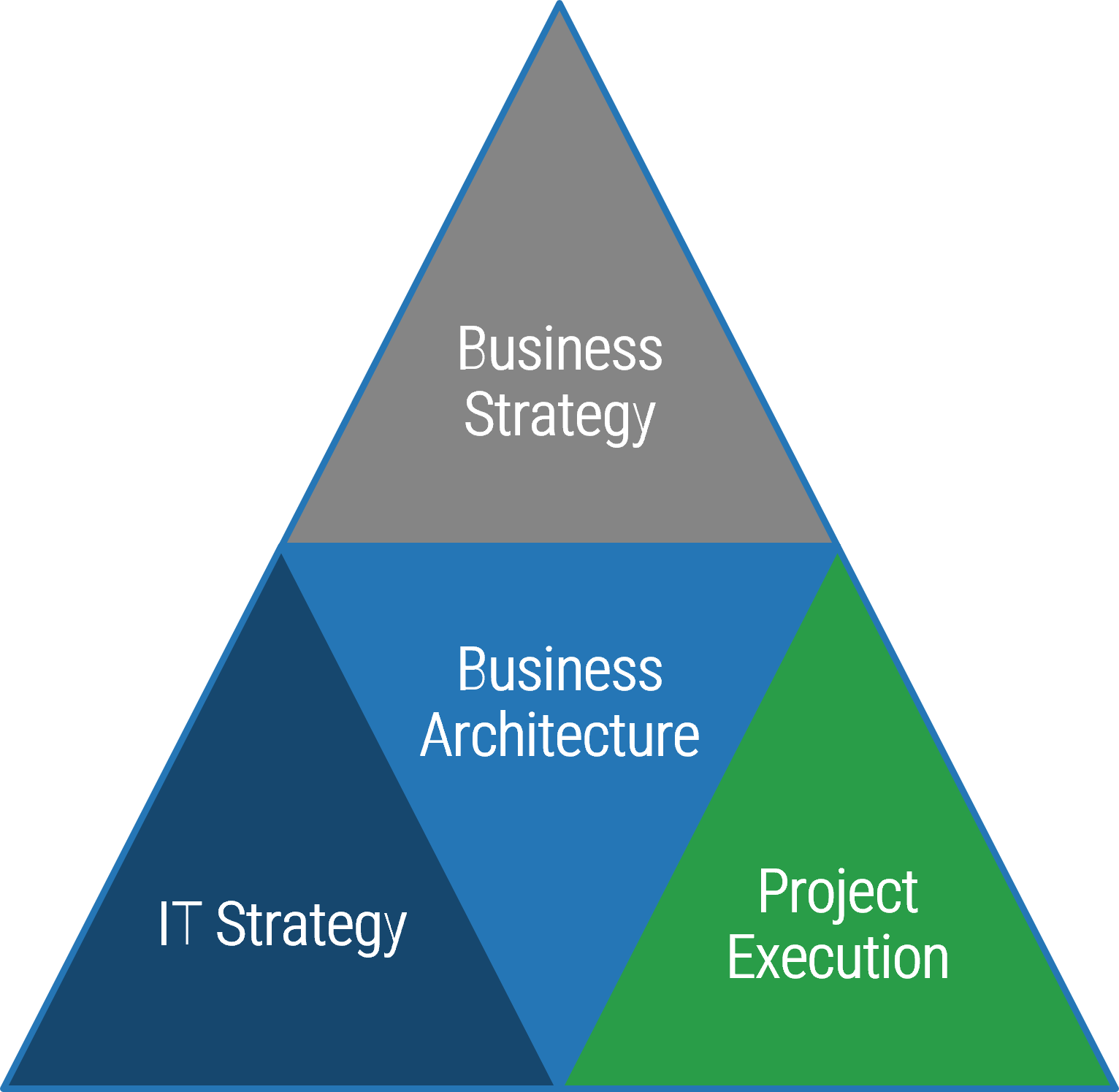
Business architecture is a planning function that connects strategy to execution
Business architecture provides a framework that connects business strategy and IT strategy to project execution through a set of models that provide clarity and actionable insights.
How well do you know your business?
As an organization moves from strategy to execution, it is often unclear how execution decisions are being made, why priority is given to certain areas, and how the planning function operates.
The business architect’s primary role is to model and document this process, creating a unified view of how strategy connects to execution so it is clearly understood across all levels of the organization.
Business architecture must be branded as a front-end planning function to be appropriately embedded in the organization’s planning process.
Brand business architecture as an early planning prerequisite based on maintaining clear communication and spreading an awareness of how strategic decisions are being made.
Engaging in business architecture brings a positive ROI
“Business architecture enables leaders to execute business strategies based on complete business transparency with full clarity and insights into the scope of business and technology impacts while defining a clear path forward.” (The Business Architecture Guild)
230% was the internal rate of return (IRR) over five years for conducting business architecture.
Major initiatives over five years leveraging business architecture saved on average 9-12 months (Lambert, 2020)

Business architecture links the organization

Interdisciplinary
Business architecture is a core planning activity that supports all important decisions in the organization (e.g. organizational resources planning). It’s not just about IT.Connecting
Digital transformation and modernization cannot work with silos. Connecting silos requires knowing the organization and its functions and recognizing where the silos are not communicating.Foundational
The best way to answer the question “Where do we start?” or “Where is our investment best directed?” comes from knowing your organization, what its core functions and capabilities are, and where there is work to do.
Business architecture building blocks and domains
A core component of business architecture is the domains, which are represented by artifacts called blueprints.
These blueprints can be:
- Heat-mapped to assess the performance, impact, effectiveness, efficacy, customer satisfaction, etc. of various components of the enterprise, which can then be prioritized accordingly.
- Cross-mapped to connect with other blueprints or disciplines to address specific stakeholder concerns and needs.

(Source: “The Business Architecture Body of Knowledge (BIZBOK) V13,” Business Architecture Guild, 2024)
Info-Tech Insight
Often, business architecture practices are not afforded the time and resources to build out all the blueprints for business architecture upfront.
Identify high-value stakeholders and organizational needs that business architecture can support. Value streams and business capabilities are common blueprints to build out the foundation for any business architecture practice. Validate, expand, and improve these assets on a recurring basis or when needs change.
Business architecture is a set of shared and practical views of the enterprise
Business architecture represents real-world aspects of a business and illustrates how they interact.
Many different views of an organization are typically developed. Each view is a diagram that illustrates a way of understanding the enterprise by highlighting specific information about it:
- Business strategy view captures the tactical and strategic goals that drive an organization forward.
- Business capabilities view describes the primary business functions of an enterprise and the pieces of the organization that perform those functions.
- Value stream view defines the end-to-end set of activities that deliver value to external and internal stakeholders.
- Business knowledge view establishes the shared semantics (e.g. customer, order, supplier) within an organization and the relationships between those semantics (e.g. customer name, order date, supplier name) – an information map.
- Organizational view captures the relationships among roles, capabilities, and business units, the decomposition of those business units into subunits, and the internal or external management of those units.

Business architecture is part of the EA framework

Each EA domain answers different questions
Business Architecture
- How does the organization create and capture value?
- How do IT and the business align with each other?
- How is the organization structured to deliver value?
- Are there duplication, gaps, or conflicts in business efforts?
- Are my capabilities, strategies, initiatives, and client offerings of the business optimized?
- Who are my stakeholders and are their needs being met effectively?
- Is the business optimally supported by IT (security, data, applications, and infrastructure)?
- What business information is leveraged and when?
Digital Architecture
- What value do your customers/external stakeholders get from your organization?
- How much complexity is there in interacting with external stakeholders?
- What opportunities exists to streamline interaction with external stakeholders?
Security Architecture
- Does my security program cover all aspects of the organization?
- Do I have clarity into who and when someone can access applications?
- Is my information secure and have I considered all aspects of data?
Data Architecture
- What information is critical to the business?
- How does data move across the organization?
- How do I ensure that information is safe and secure?
- How can I use data in innovative ways to derive actionable insights?
Application Architecture
- What applications are being used within the organization?
- How effectively are the applications supporting users?
- How are applications connected to each other?
- Where can we optimize application costs, usability, and supportability?
Infrastructure Architecture
- Where is the organization’s infrastructure located?
- Can we withstand major network disruptions?
- How secure is my IT infrastructure?
- What areas of the infrastructure can be optimized to meet business needs?
EA optimizes outcomes for the entire organization
Benefits of Enterprise Architecture
- Focuses on business outcomes (business centricity).
- Provides traceability of architectural decisions to/from business goals.
- Provides ways to measure results.
- Provides consistency across different lines of business by establishing a common vocabulary and standards, reducing inconsistencies, duplications, and costs.
- Presents an actionable migration to the strategy/vision through short-term milestones/steps.
- Increases agility, mitigates risk, stimulates innovation, and enhances competitive advantages
Business architecture grounds, provides business context, and enables the EA practice and stakeholders to drive better business outcomes across the enterprise.
Info-Tech Insight
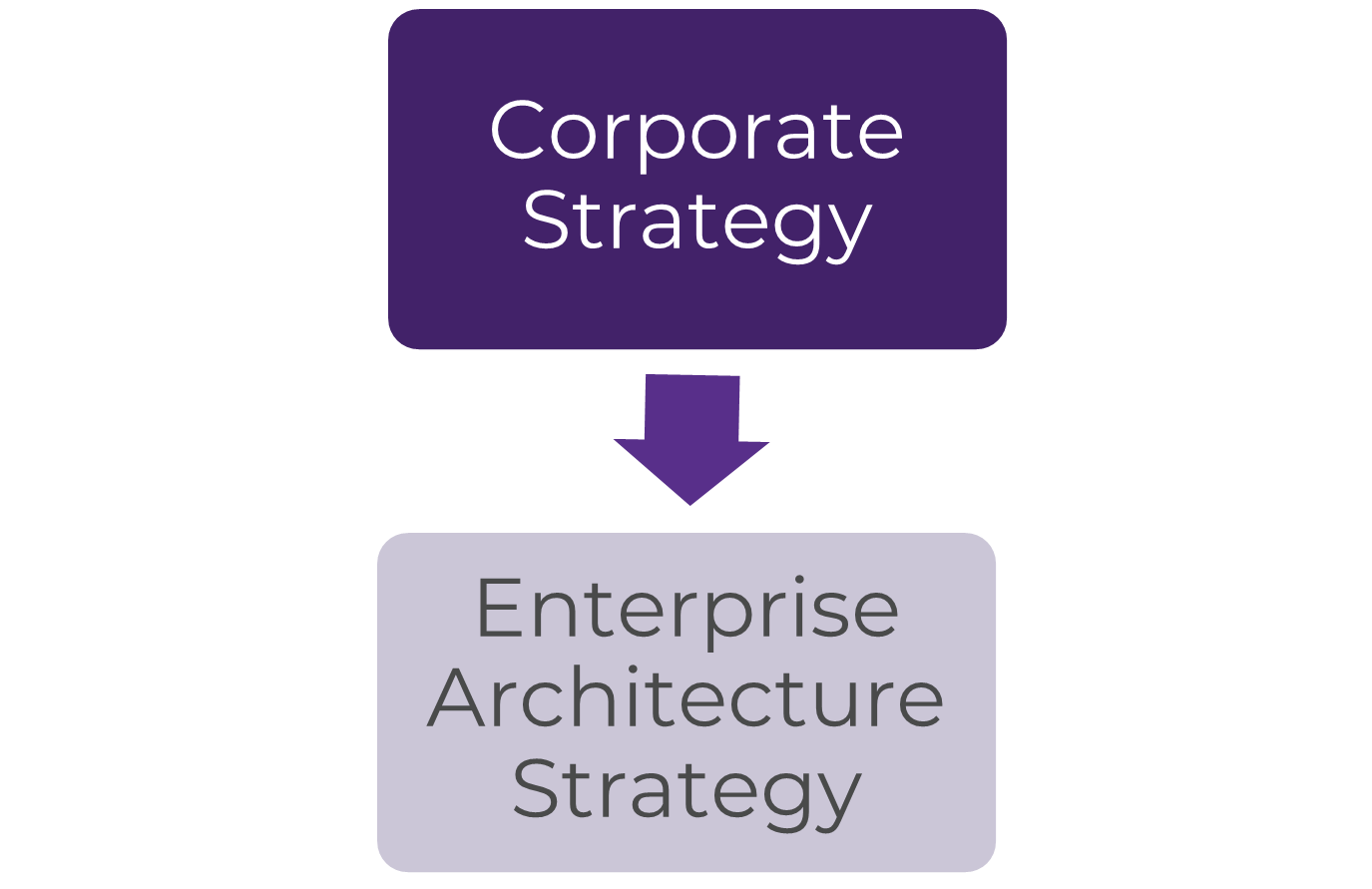
Enterprise and business architecture are not just IT competencies. They need to be informed by the corporate strategy of the organization. Similarly, their governance needs to be informed by the corporate governance. If this is not the case, it is like planning and governing with your eyes closed.
Business architecture in context

Info-Tech Insight
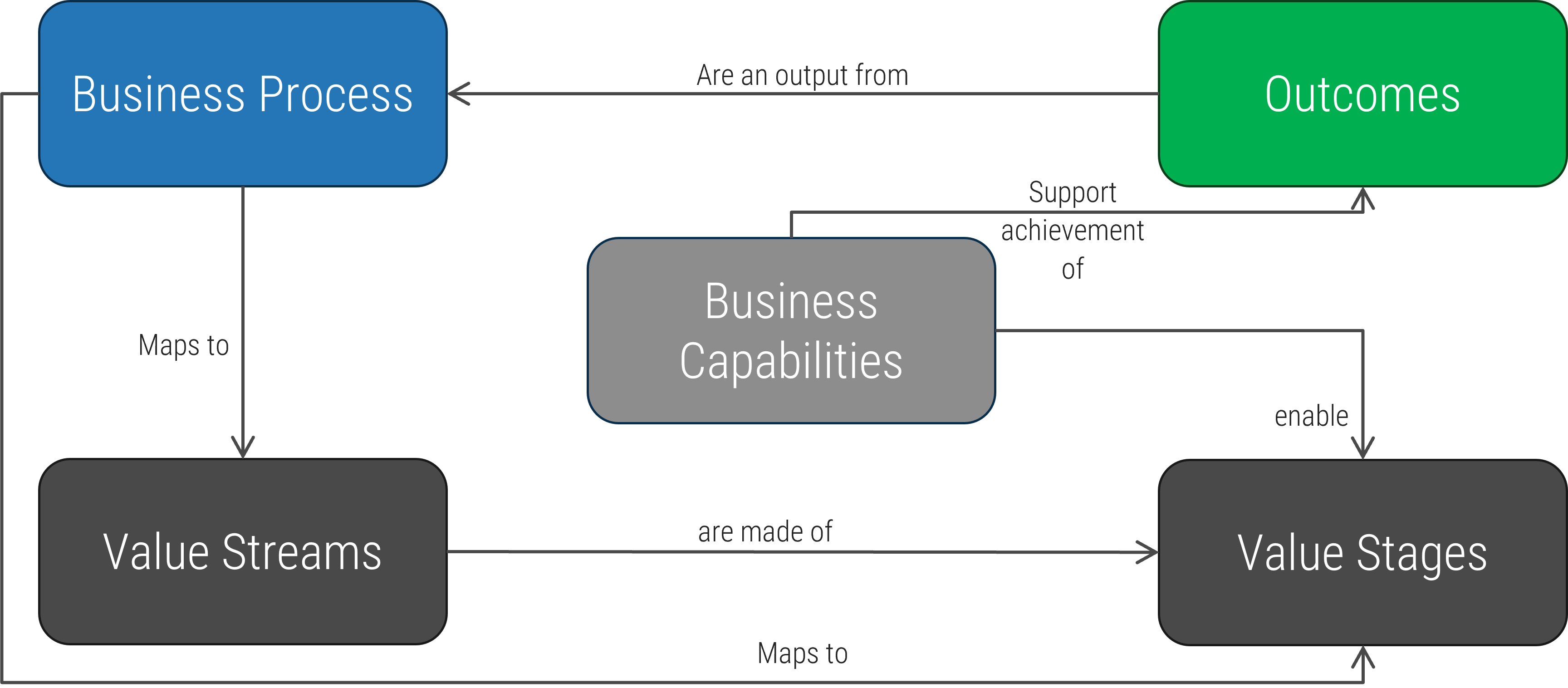
Business architecture is the “what” and “why” of business processes, and IT solutions are the “how.” Business architecture perspectives provide business context and alignment.
Understanding business architecture activities in context
(Adapted from “The Business Architecture Body of Knowledge (BIZBOK) V13,” Business Architecture Guild, 2024)
Your business architecture components will evolve over time
Identifying how much time you need to reach the target will help prioritize the work, stakeholders, and outcomes that are needed to establish it.
To define the target state maturity of the business architecture components you must set a time horizon to target.
While common timelines are often three to five years, a great deal can be accomplished much sooner.

About Info-Tech
Info-Tech Research Group is the world’s fastest-growing information technology research and advisory company, proudly serving over 30,000 IT professionals.
We produce unbiased and highly relevant research to help CIOs and IT leaders make strategic, timely, and well-informed decisions. We partner closely with IT teams to provide everything they need, from actionable tools to analyst guidance, ensuring they deliver measurable results for their organizations.
What Is a Blueprint?
A blueprint is designed to be a roadmap, containing a methodology and the tools and templates you need to solve your IT problems.
Each blueprint can be accompanied by a Guided Implementation that provides you access to our world-class analysts to help you get through the project.
Need Extra Help?
Speak With An Analyst
Get the help you need in this 3-phase advisory process. You'll receive multiple touchpoints with our researchers, all included in your membership.
Guided Implementation 1: Understand Your Business Context
- Call 1: Share objectives and review key sections of the blueprint.
- Call 2: Discuss strategy and align on goals and objectives.
- Call 3: Identify stakeholders and introduce value stream activity.
Guided Implementation 2: Define Your Value Streams
- Call 1: Discuss value stream activity outcome and introduce value stage activity.
- Call 2: Discuss outcome of value stage activity.
Guided Implementation 3: Develop Your Business Capability Map
- Call 1: Build a level 1 BCM.
- Call 2: Decompose to a level 2 BCM.
- Call 3: Discuss heat-mapping the BCM.
- Call 4: Summarize results and plan next steps.
Contributors
- Shibly Hamidur, Enterprise Architect, Toronto Transit Commission
- Danial Lambert, Vice President, Benchmark Conulsting
- Filip Hendrickx, Founder, altershape
- Eight Anonymous Contributors
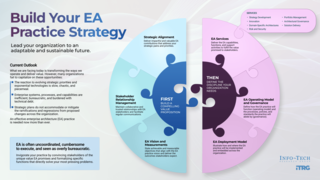 Build Your EA Practice Strategy
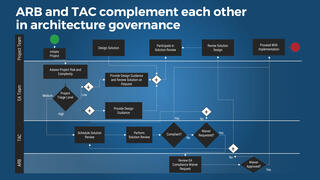 Agile Enterprise Architecture Operating Model
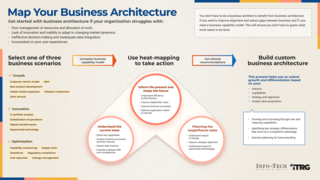 Map Your Business Architecture
 Drive Digital Transformation With Platform Strategies
 Create a Right-Sized Enterprise Architecture Governance Framework
 Excel Through COVID-19 With a Focused Business Architecture
 Create Stakeholder-Centric Architecture Governance
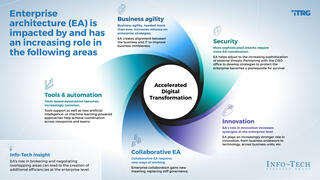 Enterprise Architecture Trends
 Prepare for AI Regulation
 Establish Your Adaptive AI Governance Program: From Principles to Practice
 Build a Better Enterprise Architect
